Why the smartest leaders dig underground
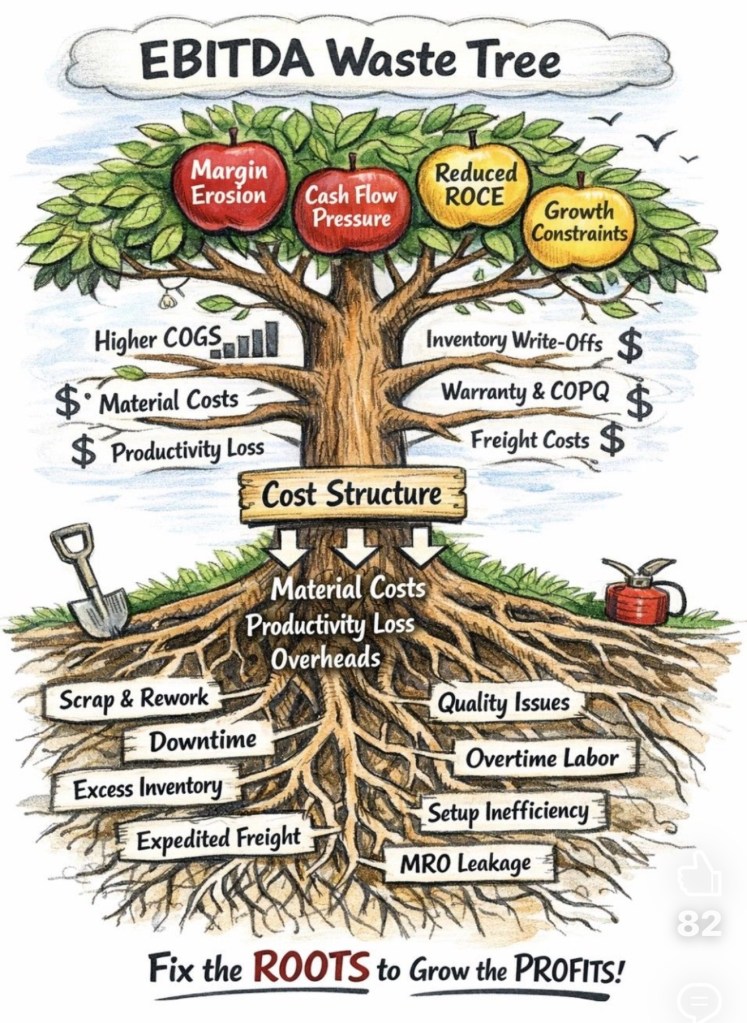
Walk into almost any boardroom and you’ll see the fruit on display.
Margin.
Cash.
ROCE.
Growth.
They’re reviewed monthly, debated quarterly, forecasted endlessly. When they’re healthy, everyone relaxes. When they soften, pressure rises fast.
But the fruit is a lagging indicator.
You cannot polish it.
You cannot negotiate with it.
You cannot demand that it improves next quarter.
You can only influence the system that produces it.
That system is what I call the Profit Impact Tree.
1. The Fruit: What Everyone Watches
Let’s start at the top.
When performance drifts, it rarely shows up as “waste.” It shows up as:
Margin pressure, Cash strain, Reduced capital efficiency, Growth constraints
The symptoms feel financial, so the response often becomes financial.
Cut discretionary spend.
Freeze hiring.
Delay investment.
Push suppliers.
Drive price.
Sometimes those actions are necessary. Often they are defensive reactions to deeper structural issues.
But fruit doesn’t rot on its own.
It reflects what is happening below.
2. The Trunk: Cost Architecture
Between daily operational activity and financial outcomes sits your cost architecture.
In most manufacturing businesses, it breaks down into three structural drivers:
Material costs, Productivity (labour and asset utilisation), Overheads
These aren’t line items. They’re structural design choices.
Material cost isn’t just purchase price. It’s:
Supplier selection
Engineering tolerance discipline Inventory strategy
Obsolescence control
Change management
Productivity isn’t just headcount. It’s:
Flow design
OEE
Changeover discipline
Planning accuracy
Skill deployment
Overheads aren’t just “fixed costs.” They reflect:
Complexity
Duplication
Governance layers
System inefficiencies
Your trunk is the accumulation of thousands of operational design decisions.
And here’s the uncomfortable truth:
Most organisations try to improve fruit without redesigning the trunk.
3. The Branches: Where Waste Becomes Financial Pain
Waste doesn’t appear on a P&L labelled “poor discipline.”
It shows up disguised as:
Elevated cost of goods sold Inventory adjustments Warranty and quality costs Premium freight
Labour inefficiency
Finance sees percentage shifts.
Operations sees stories.
A late Engineering Change triggers scrap.
A supplier miss triggers downtime.
Downtime triggers overtime.
Overtime triggers fatigue.
Fatigue triggers defects.
Defects trigger warranty.
Warranty triggers margin erosion.
One root cause.
Five financial consequences.
The best leaders are bilingual. They translate operational language into capital language.
They don’t argue about cost absorption rates.
They ask what created the absorption problem.
4. The Roots: Where Leadership Actually Matters
This is the part most executives never see directly.
The real drivers are underground:
Scrap and rework
Equipment downtime
Excess inventory
Expedited freight
Quality escapes
Overtime reliance
Long changeovers
MRO leakage
These rarely make headlines in executive summaries. But they compound.
A 1% scrap rate sounds trivial — until you calculate:
Material loss
Labour to rework
Schedule instability
Planning noise
Inventory distortion
Working capital impact
Now multiply that across multiple sites, value streams, and product families.
Small roots feed big outcomes.
5. The Illusion of Control
There is a particular trap senior leaders fall into.
When fruit declines, they push harder at the top of the tree.
More reporting.
More reviews.
More pressure.
More targets.
The unintended effect?
People start protecting fruit.
They delay reporting scrap.
They defer maintenance.
They push inventory into next month.
They ship partial orders.
They overproduce to protect absorption.
You can force the tree to look healthy for a quarter.
You cannot force it to be healthy.
Only root work builds resilience.
6. Capital Efficiency Is an Operational Outcome
Many leaders treat ROCE and cash conversion as finance constructs.
They’re not.
They’re operational consequences.
Excess inventory is not a finance issue. It’s:
Planning instability
Batch size design
Setup inefficiency
Supplier unreliability
Forecast noise
Premium freight isn’t a logistics problem. It’s:
Poor sequencing
Late engineering release Changeover inflexibility
Weak SIOP discipline
Warranty isn’t a customer service issue. It’s:
Process capability
Standard work adherence Inspection design
Skill variance
Capital efficiency improves when operational variance reduces.
That’s it.
7. Why Most Transformations Fail
Because they prune branches.
Cost-down programs focus on:
Negotiation
Headcount
Budget compression
Travel bans
Spend freezes
These create short-term financial relief.
But they don’t redesign flow.
They don’t improve capability.
They don’t simplify complexity.
They don’t stabilise processes.
And so the roots regrow.
The companies that outperform over a decade do something different.
They treat operational waste as a structural threat to capital efficiency.
They align improvement to financial architecture.
They don’t ask, “How do we save £5m?”
They ask, “What is structurally creating £5m of waste every year?”
That question changes behaviour.
8. A Leadership Lens Shift
If you want this model to work in your business, the shift is simple but uncomfortable:
Stop asking:
“How are we performing?”
Start asking:
“What is feeding the tree?”
In practical terms:
Instead of reviewing margin first, review:
Scrap trend
OEE stability
Changeover time
Inventory ageing
Schedule adherence
Instead of debating ROCE, review:
Batch sizing
Engineering release discipline
Obsolescence exposure
Value stream flow
When the roots are stable, fruit follows.
When roots are unstable, fruit volatility is inevitable.
9. The Multi-Site Complication
In a global footprint, root issues amplify.
One site tolerates 6% scrap.
Another runs at 2%.
The average looks acceptable.
But capital is being destroyed quietly.
ERP differences, duplicated overhead, inconsistent change control — these are not IT issues.
They are root-level design choices.
And they determine whether capital compounds or leaks.
Consistency in operational discipline is a capital allocation strategy.
10. The Cultural Dimension
Here’s where it becomes interesting.
If you only attack waste with cost language, people defend.
If you attack waste with capability language, people engage.
There is a difference between saying:
“We need to cut £3m.”
And:
“We are redesigning flow so the system stops creating friction.”
The second invites ownership.
The first invites fear.
Sustainable performance requires psychological safety at root level.
People must feel safe surfacing waste.
11. The Long View
The market rewards consistency more than heroics.
A business that:
Improves setup times annually Reduces scrap systematically Tightens planning discipline Eliminates MRO leakage Simplifies product complexity
Will compound capital efficiency year after year.
It won’t always look dramatic.
But five years later, the fruit will be larger, more predictable, and less volatile.
That is strategic advantage.
12. The Core Insight
You do not improve EBITDA directly.
You eliminate the systemic friction that suppresses it.
You do not improve ROCE directly.
You reduce operational variance that inflates capital.
You do not unlock growth directly.
You remove constraints that make growth unstable.
Fruit is a reflection.
Roots are the lever.
Final Thought
When leaders walk the factory floor, they often look up — at output, boards, dashboards.
The smartest ones look down.
They ask:
Where is instability tolerated? Where is complexity accepted? Where are we compensating rather than correcting? What are we repeatedly firefighting?
Those are the roots.
Fix them patiently.
Design the trunk deliberately.
Align the branches financially.
The fruit will take care of itself.

Leave a comment