In today’s hyper-connected business environment, executives face an overwhelming paradox: the more digital tools we adopt to stay organised, the more fragmented and reactive our work can become. After years of testing every productivity system imaginable, I’ve discovered that true effectiveness comes from a strategic blend of cutting-edge digital infrastructure and deliberately analogue capture methods. I’m sharing here my evolved system for managing details, note taking, and task management—a system that delivers both immediate tactical benefit and long-term strategic clarity, transforming how I lead, decide, and execute at my leadership level.
Why Simplicity (KISS & Complexity Resolved)
Simplicity is complexity resolved—a phrase we sometimes hear attributed to Steve Jobs, but its roots go deeper, to the artist Constantin Brâncuși, a sculptor, painter and photographer widely regarded as one of the most influential artists of the 20th century. The K.I.S.S. principle (“Keep It Simple Stupid”), famously adopted by the US Navy and Kelly Johnson at Lockheed’s Skunk Works, the creator of the U-2 spy plane, reminds me daily that the best systems cut through chaos. When I tackle a business issue or map a way forward, these two philosophies anchor my thinking.
A recent problem I have worked through is trying to keep on top of so much work and to remain effective.
Digital vs Analogue – Why Notion isn’t Enough for me
I’ve trialled countless digital productivity platforms. Today, I use Notion, as my digital “second brain,” is my go-to for everything from calendar management to email capture. It’s flexible, customizable, and integrates beautifully. I use Thomas Frank’s Second Brain template, every day, it is perfect for me as my digital repository, especially now with Notion Ai which really helps me connect the dots over a week or month.
Yet, it isn’t perfect. There’s a gap when you want to be truly present: on a factory floor, in coaching, during real-world interactions.
When someone pulls out a phone in a meeting, what does it convey? For me, it signals distraction, which, makes me feel that what I have to say is unimportant to that person. Meanwhile, if the person opens a notebook, for me, that signals genuine engagement. This is not just perception—it’s about how we respect each other and absorb what matters.
https://www.notion.com/product
https://thomasjfrank.com/brain
How My System Works
Over several years, I have built on the Ryder Carroll Bullet Journal method— I love its flexibility and simplicity, it truly works. But as my global remit expanded and work complexity increased, Bullet Journaling just couldn’t keep pace for me or give me the space to capture details and process my thoughts. I had fragmented notes, lost ideas and a lack of linkage: as a knowledge worker, that’s a critical vulnerability that I had to close. For most people, the Bullet Journal method is perfect, I have learned from this and still utilise many of the principles in this system.
https://bulletjournal.com/pages/rydercarroll
After scouring YouTube, I discovered a niche journalling sub-culture blending form and freedom: Hobonichi Techo journals that use Tomoe River paper, a highly acclaimed Japanese stationary which is coveted by fountain pen enthusiasts for its standout qualities that enable beautiful handwritten notes. But this approach isn’t just artistic—it’s functional for leadership. The paper is so thin, but with minimal ghosting means that a small, slim book, is enough to cover over a year of notes!
Why Hobonichi? The Core Tools
The Pocket Book
Hobonichi Techo A6 Original—my “Life Book.” It holds everything important (and unimportant), is always with me, and is my go-to daily prompter, and, it literally fits in my pocket.
Used for capturing thoughts, emotions, top priorities, and a high-level calendar outline.
When I’m at the Gemba (the actual place where value is created—“the workplace” in lean terminology), this is my analogue “inbox.”
I check it first thing, usually with coffee, before emails.
Paired with my Bastion black rollerball—it’s perfection!
https://www.1101.com/store/techo/en/
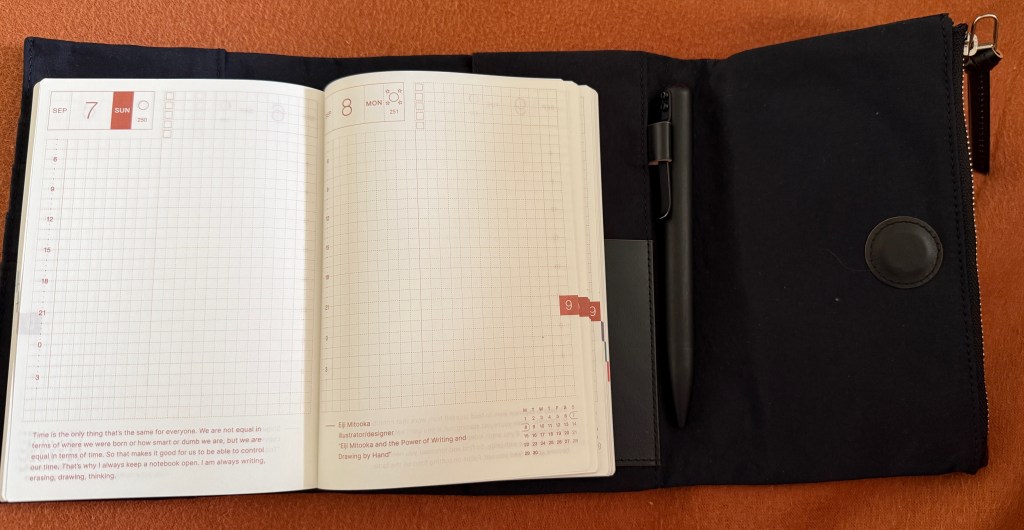
The Hon
Hobonichi Hon A5 Hardback—this book lives in my briefcase and I love it, it is the heart of my system, giving me space to think.
This allows me to expand on my schedule, adding detail to agenda, purpose, and objectives.
Captured ideas/actions from the Pocket Book are filtered here, evaluated, and then—if valuable—migrate into Notion for digital completeness.
Is this still KISS? Absolutely. The cadence is simple and frictionless: Pocket Book drives Hon, which is the system’s heart and “gatekeeper” for my digital domain. Analogue forces deliberate thought—no distractions.
Meeting Book
Leuchtturm1917 Master Classic—for meetings, I need detail at both executive and granular levels.
The book is beautiful, simplistic and beautiful.
This is where I leverage the BUJO style, for tasks and agenda details, but is primarily my meeting note taking centre as it gives me space to write.
Full A4 hardback, thick paper, formless but empowering.
Daily schedule, priorities, and most crucially: meeting notes. If I write it, I remember it.
Blanks let me span a single day across multiple pages, or capture action points that eventually feed back into the Hon.
https://www.leuchtturm1917.co.uk/notebooks/all-formats/master-a4/
Cadence & Purpose – Overview of My Note-Taking System
So here is the overview of my note taking system, my cadence of activity between the books and Notion and the purpose of each
Hobonichi Techo A6
- My pocket book, always with me
- Used at any moment for quick capture
- Adhoc thoughts, reflections, emotions
- Calendar high-level outline
- Gemba notes
- For both personal and business
- Weekly reflection feeds into Hon
Hobonichi Hon
- Heart of my system, always in briefcase
- Main planner and thinking space
- Full calendar, full action list
- Purpose and objectives clarified
- Updated daily from meeting notes
- Weekly digital sync from Techo and Notion
Leuchtturm1917 Master Classic
- Detailed meeting notes
- Daily tasks
- Daily agenda
- Meeting action capture
Executive Impact & Business Benefits
Why does this system work for a director, SVP, or CEO? Because it deliberately links the fast-moving digital world to the depth of handwritten reflection. Since embracing this blended approach, I’ve reduced missed actions, improved my effectiveness in critical meetings, and enhanced strategic follow-through. The analogue tools foster intentionality; the digital tools capture, connect, and track.
If you’re a leader or manager wrestling with knowledge overload, consider a hybrid approach. Try introducing just one analogue tool into your workflow this week—see how it influences your attention, memory, and decision quality. Challenge yourself: what frictionless, human-centered system could you build to serve your own leadership journey?

Leave a comment