I had a ‘like’ from another blogger recently (thanks Peace of Mind), as happens from time to time, nice blog, you can see it here.
Todays blog is a mini-post!
One of their posts got me thinking about all the change we face, especially as agents of change ourselves (some might say agents of chaos!). So here are some thoughts on that.
We are all different, in as many ways as there are people, think about that for a moment.
Then consider how change impacts people, and you will quickly come to learn that there is no right or wrong way to deal with change, except to respect people, their viewpoint, their thoughts and expressed emotions on change.
For most people, change is hard, constant change, as it is, is perpetually hard. We go through life, and as change leaders we may compartmentalize our work as ‘work’ but to the receiver, we are changing their life, how they perceive that is important and will effect the outcome of the change you are driving.
What we need to understand is that these are people, with their own worries, fears, experiences, challenges and personal issues that we do not see. These things all impact the change itself and maybe more importantly for the change agent, if the change will ‘stick’. What some may not consider is that the feedback loop from those receiving the gift of change, gives the change agent back the gift of change, so he or she is also dealing with constant and ever spiraling change upon every exchange, because after all, the change agent is also a person with their own worry and fears etc.
So how do we handle this gift of change all the time?
There are many formal change management models, one of the most popular being ADKAR (Awareness, Desire, Knowledge, Ability, Reinforcement) around which ProSci have built a beautiful model (and business), and I would very much advocate getting certified by them, it is very robust. Alternatively, you could consider philosophical standpoints such as Bruce Lee’s “Be like Water”. This of course is strongly directed at martial arts and his fighting style of Jeet Kune Do, but I also take it as the philosophical viewpoint of being like water which is to flow through change, cut through rocks when I need to and bring crashing strength when I need to but to also be gentle and nurturing to things around me, help others grow and respect people.
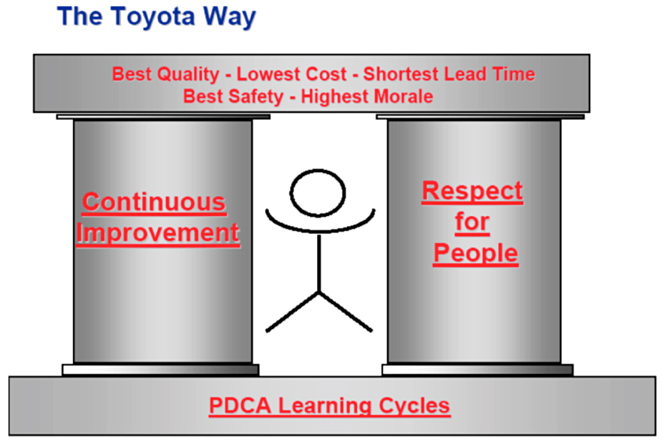
Respecting people was indeed one of the original tenets of Toyota’s successful development of the The Toyota Way, their model explicitly called out respect for people, this was defined as their management model to help them drive The Toyota Production System (TPS). This image is directly from The Lean Enterprise Institute, and is their material, they are a great resource to go research everything to do with Lean.
So what does all this mean to the change agent, or to the person receiving the gift of change?
Firstly, for the change agent, when driving change, have your ears and eyes open, think first, then act, but do not stall, be open and honest. Listen to the resistance, respect the resistance, do not think that because there is resistance, there are bad people. Be aware and mindful that we all see things differently and you do not know the other persons life. Respect for people, means this, but also to ensure you have given that person or group everything they need to succeed, do not treat knowledge as power, empower others. If you treat others in this way, change becomes easier to deliver from an emotional and dare I say spiritual perspective but also it is more effective for the business. Maintain your integrity at all times, this is vital, if you fundamentally disagree with a change you are tasked with delivering, and you do it anyway, this will cause you pain. Seek to understand first, then ensure you are aligned internally and if so, act with integrity, use your Emotional Quotient to support those going through the change, as you will also be going through change at the same time. Take time out regularly to reflect, follow the Plan Do Check Act cycle, the Check part is your opportunity to reflect and then Act upon your reflections.
The receiver of change has a wide and varied viewpoint, I treat this person as I would my own family. For them the change can be a shock or a pleasant surprise or just something of no interest at all. My advice for these people is to first ‘take a breath’ to understand that change is inevitable, as per the title, it is the only constant. Each of us go through change every day, we cannot avoid it, it is life. If we take that standpoint, we must have a strategy to handle change, for some, that strategy is to be the victim, or agnostic or to fight it largely driven by emotional response and the balance of the chemicals in the brain (dopamine, cortisol, etc). Choose your strategy wisely and adapt it as needed, the best way to handle change is from a philosophical position if you can. Understand the change first then consider your strategy, try not to position yourself before you understand the change fully, be curious.
More to come on this in the coming weeks, let me know what you think, how do you handle change?

Leave a comment